Overview
Replacing Two or More Missing Teeth
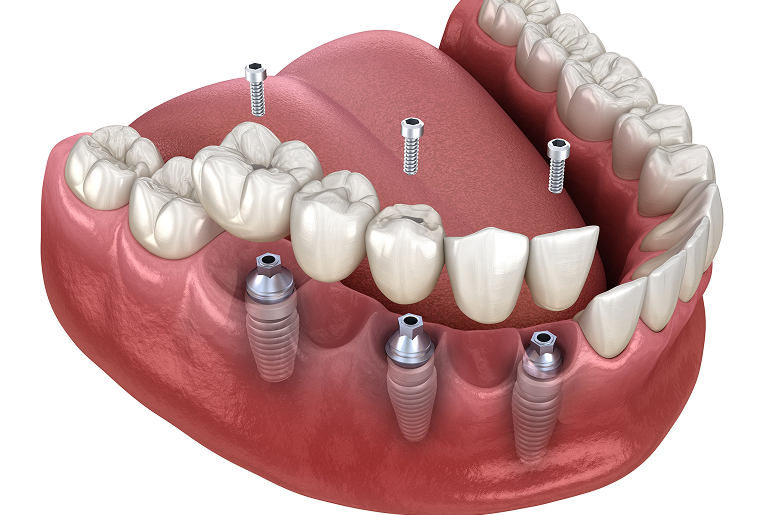
When you are missing two or more consecutive teeth, multiple tooth dental implants offer an implant-supported bridge that fills the gap permanently — no dentures to remove, no adhesives, and no modification of the healthy teeth on either side of the gap.
Rather than placing one implant for every missing tooth, two or more strategically positioned implants support a fixed bridge that spans the entire space. This efficient approach provides exceptional stability while keeping costs lower than placing individual implants for each tooth. The result is a seamlessly integrated restoration that looks and functions like your natural dentition.
Implant Bridge vs. Traditional Bridge
A conventional bridge relies on crowning the teeth adjacent to the gap — permanently reducing them in size — to support the artificial teeth in between. An implant-supported bridge is anchored into the bone itself, leaving neighboring teeth completely intact and stimulating the underlying bone to prevent deterioration.
Two or three implants can support a bridge of several teeth, making this approach more efficient than placing an individual implant for each missing tooth.
The fixed bridge is permanently secured to the implants, providing chewing stability that matches or exceeds natural teeth — no movement or shifting.
Implant posts stimulate the bone beneath the bridge, preventing the bone loss and facial changes that result from prolonged tooth absence.

The Procedure
How Multiple Tooth Implants Are Placed
The first appointment involves placing two or more implant posts into the jaw at the positions determined during your 3D imaging consultation. This is an outpatient procedure performed under local anesthesia or IV sedation. Most patients experience minimal downtime and return to work within a few days.
The implants then undergo osseointegration — the natural process by which the titanium fuses with surrounding bone — over a period of three to six months. A temporary bridge may be provided during this healing phase so you always have functional, aesthetic coverage over the gap.
Once healing is confirmed, an abutment is connected to each implant and the final custom-fabricated bridge is securely attached. The bridge is crafted to match the color, contour, and feel of your natural teeth, completing a restoration that is virtually indistinguishable from the real thing.

Candidacy
Who Is a Good Candidate?
Patients who are missing two to six consecutive teeth and have adequate bone density at the implant sites are typically good candidates for a multiple tooth implant bridge. Good systemic health, healthy gums, and a commitment to proper oral hygiene are also important factors.
If bone loss has occurred in the area of the missing teeth, a bone grafting procedure may be recommended before implant placement to ensure solid support. Dr. Hoover will review all options with you at your consultation and develop a personalized treatment plan.
This depends on the number of missing teeth and the location in the jaw. A two-tooth gap typically requires two implants, while a longer bridge may be supported by three. Dr. Hoover will determine the ideal configuration during your consultation.
Yes. Once fully healed and the permanent bridge is in place, you can eat virtually any food — including hard and crunchy foods — with confidence. The bridge behaves exactly like natural teeth.
Daily brushing and flossing are essential. Your dental team will instruct you on the best technique and tools — such as interdental brushes or a water flosser — to keep the area under the bridge clean and healthy.